Friday, July 31, 2015

Kalam-Krupa

It was Ashadhi Ekadashi. I was observing a fast, and was working on my laptop, listening to some vitthala bhajans on my headphones. As usual, I had turned off the internet on my cell phone while working, in order to avoid the seemingly unstoppable whatsapp notifications. Disconnected from the net, I was blissfully ignorant of what was happening in the rest of the world. I took a break around noon, walked around, came back, and turned on the data on my phone just for a moment. And most of my active whatsapp groups were abuzz with the news: Abdul Kalam passed away, suffered a heart attack while addressing students at IIM Shillong. I was shocked, like crores of other Indians. I searched the net; the news was confirmed. An abhanga by Tukaram Maharaj was still playing in the background: "अणुरणिया थोकडा, तुका आकाशा एवढा". Tukaram, while describing his experience of self realization, says: Though I am insignificant as an atom, I am also as vast as the skies! Dr. Kalam has left the insignificant mortal body and has become one with the परब्रह्म (parabrahma). I couldn't stop my tears from flowing down my cheeks. After a couple of minutes, as I read through the news reports, the feeling of grief was replaced by a feeling of satisfaction and inspiration. He was 83, had accomplished the highest honors in life, and was still doing what he loved the most when he left us. What more can one ask for in life - or death? It was a death befitting a true karmayogi. Om Shantih.

Over the next few days, as the obituaries and eulogies started pouring in, I started reflecting on what his role in my life has been. And I realized that his life story has been a blessing —krupa— for me (and crores of others), even though I never had a chance to meet him.

I heard his name for the first time, in late 1990s from my father, who was reading the Vision 2020 book. With the help of my maternal grandfather, who was a retired professor of political science, my father pointed out some minor error in a reference in the book and wrote to Dr. Kalam; he promptly responded acknowledging the error. After that, my father read his two other books—Wings of Fire and Ignited Minds, and started telling us about him and quoting him in his talks, in the sangha circles and outside.
"Punyaatma, punya-neta, punyaadhikari.." - I still remember - ".. if the population of all the three were to increase in our society, then India would become the jagadguru" (Ignited Minds)
Many of my friends, my father's friends and colleagues at work as well as in the sangha were introduced to Abdul Kalam's work by my father. Later, one of his colleagues, Prof. Dabir, presented Kalam's life in the form of a kirtan. In July 2002, when Dr. Kalam became the President of India, many people who had heard about him through my father called at our home to congratulate my father!

I was a highschool student when I heard about Kalam first, and being from a Marathi-medium school, reading the English Wings of Fire proved a bit tough for me. Thankfully, the Marathi translation अग्निपंख (Agnipankha) was available and is equally inspiring. When I went to college, my father gifted me Ignited Minds. During the same time, I happened to meet Dr. Mohan Bhagwat at a sangha shiksha varga near Surathkal. He asked me if I was reading any new books, and when I told him about these two, Mohan ji remarked, "Very good, his books are like our sangha baudhiks." Both these books had a great impact on me. Many incidents from Kalam's life and many quotes from his books still reverberate in my mind. I remember how he shares that the front page of the newspaper he opened on a morning in Tel Aviv was full of Israel's successful experiments with farming in the desert—a positive news, even though there was a terror attack just the previous night—it was covered on inner pages. This attitude of focusing on and highlighting our positive side, and not our problems, needs to be internalized by individuals as well as societies. His tryst with failure —when he wanted to become a pilot, went to Delhi to give the test, was ranked ninth on the list, and only the first eight were selected— is a representative scenario for every youth; the type and intensity of "failure" might vary. And what happened after that is an inspiration and a life lesson. In that disappointed, dejected state of mind he went to the Himalayas. By some divine force, he found himself at Swami Sivananda's Divine Life Society in Rushikesh. "Forget this failure, as it was essential to lead you to your destined path", Swamiji told him. The world knows that Kalam's destiny was not in flying a military aircraft, but in designing much mightier missiles for our nation. Swami Sivananda reportedly also reiterated Bhagwan Krishna's mantra: "Defeat the defeatist tendency". Kalam notes that this mantra comes to him whenever he is in trouble. I must say this incident has made a great impact on my own life and has kept me untouched by any depression or negative thoughts.

Kalam, along with Swami Vivekananda, Chhatrapati Shivaji, and of course the Sangha, continued to guide me throughout my college life, and beyond. In the year book of my final year of engineering, in the column for inspirational quotes, I noted: "For all your days prepare, And meet them ever alike; When you are the anvil, bear; When you are the hammer, strike." This is attributed to American poet Edwin Markham, but I read it in Wings of Fire first.

In January 2009, when my sister Madhura was studying to become a dentist in Nagpur, Ram Krishna Math, Pune organized a nationwide essary competition on Swami Vivekananda's message to the youth, as a part of their silver jubilee celebration. Madhura took part in it, inspired by Swamiji's life, as well as by the prospects of meeting Dr. Kalam, who, it was declared, will be the chief guest at the award ceremony. Madhura prepared well and wrote an excellent essay in Marathi that won a consolation prize. It was a moment of great pride for my entire family when she went on to the stage and recieved the award from Dr. Kalam himself. Since the event was in Maharashtra, and hers was the only Marathi essay to win a prize, the crowd cheered her with a relatively larger applause; the celebrated chief guest was sensitive enough to acknowledge it, and spoke a few words with her. (In the same visit to Pune, Madhura and our mother got a chance to briefly meet another Bharat Ratna - Pt. Bhimsen Joshi.)


Then last year, when Dr. Kalam visited Nagpur to take part in an event organized by Vijnana Bharati. He visited Smruti Mandir, the samaadhi (memorial) of Dr. Hedgewar, the founder of the RSS, and offered tributes. My father was one of the sangha karyakartas who received him at the venue.


We all know about the achievements of Dr. Kalam: his leading the missile program that developed Agni, Nag, Pruthvi; his role in India's successful nuclear tests; his vision to use the advanced technology in defense to also make low weight, easy to use equipments for physically challenged individuals; some of his decisions while at the Rashtrapati Bhavan; and of course his larger Vision 2020 for India's comprehensive development, and tireless work for inspiring the youth towards that. These are his blossoming virtures, or things that one would put in a resume; but we remember people not so much by what they achieve, but by how they behave with us, by what are called the ripening virtues. Dr. Kalam had both aplenty, and that's what makes him special. I think the memory of his last day that his colleague, Srijan Pal Singh, has shared speaks volumes about this: him asking the security guard who had to remain standing for hours about his well being, and offering some food to him, was very touching.

He lived a great life. His being a Muslim never affected crores of his "students" ever, even before or after his presidency. Unfortunately, it was brought up after his demise. "A great Muslim died on an auspicious day of Hindus in a Christian city. He maintained secularism and democracy in death too." — a message was being shared on Twitter and Whatsapp, mindlessly, like most other forwards. It's high time we learn to look beyond such token secularism constructs. Our youth, especially those who claim to take inspiration from Kalam, should be able to critically evaluate such goodie goodie but stupid messages: how does Shillong become a "Christian" city? If the answer is because it has 60% Christian population, why do the same set of people who cheered this message frown when our country with 80% Hindu population is called a Hindu Rashtra? Secularism was not something Kalam had to show off; it came naturally to him: he quoted from Gita and Thirukkural in his speeches, he routinely met spiritual leaders of all Dharmic panths and believed in their power to transform the masses—something our "secular celebrities" would scoff at, and in a true secular step, stopped the state funded iftar parties at Rashtrapati Bhavan, donating the money to orphanages instead. Anyway. The secularism debate is a separate and serious topic, and I will perhaps write about it another time, but my point here is, if we blindly follow and forward such messages, we are not applauding the real giants like Kalam, but in fact demeaning him, by reducing his real work to such tokenism.

Kalam always did and will continue to serve as an inspiration for several generations. Our job does not stop at sharing some tweets and pics about/of him for a few days, or even circulate petitions for naming universities and roads after him (Srijan Pal thinks he wouldn't have agreed with it anyways), and then get back to the same old routine. A real tribute will be if we —all of us— work towards strengthening the punyaatma, punya neta, punyaadhikari triangle he used to talk about. That is not an easy job. Each one of us should pledge to start the work from him/herself —becoming punyaatma (viruous individual)— and work on it every moment every day. As James Froude said, "You cannot dream yourself into a character; you must hammer and forge yourself one", and as we sing in a sangha geet:
साधना नित्य साधना, साधना अखंड साधना
 saadhana - nitya saadhana, saadhana - akhanda saadhana
That's what Kalam was doing, till his last breath.

Sunday, May 24, 2015

In response to an unknown frustrated med. student

WhatsApp (and other social media) are a great source of being connected to your friends —old and new— and also for staying abreast of current affairs, sharing opinions, even creating opinions. It is also a platform for spreading rumors and wrong messages. Hardly anyone verifies what we get in a forwarded messages. Most people I know tend to ignore such messages — thankfully; some tend to question its veracity and a few take efforts to think through those and perhaps post a rebuttal. I am one of those few :-)

Today I received this message on our school group:
————————————————————— 
Dr. Praveen Angrish----

How much does it cost to educate a medical student?

6 lakhs? 13 lakhs?

Take the budget (yearly fund) of running a medical college and divide it by the number of medical students and you will get the figure.

But is this money really spent on the students?

Let's see.

What are the things bought with this money?

Medicines
ECG machines
Scanners (CT /USG)
Patient beds
Wards
Operation theatres....

THE WHOLE HOSPITAL BUILDING IS ONLY FOR THE PATIENTS!

What about the teachers?

The teachers are doctors, who are engaged full time in  treating the sick (outpatient work, ward rounds, operations, medico legal - court and certificate work)

Basically they just explain the techniques of diagnosis and treatment to the medico  during the routine work.

Theory  and seminars (pure rescuing) are rare duties for these doctors- maybe once in a week or once in a month.

But are there staff only teaching?

Yes. There are three departments which do not routinely do patient- related work routinely.

Anatomy, physiology, and pharmacology.

WHAT ABOUT THE OTHER "NON CLINICAL" DEPARTMENTS? AREN'T THEY PURELY FOR TEACHING MEDICAL STUDENTS?

Even the so called "non clinical" departments like patho and micro are full time occupied in processing blood tests, infections and tissue samples.(patient care)

So this means there are just about 45 teaching staff, four or five lecture halls, some seminar halls, couple of hostels, and an "academic section" (13 clerks) and a principal - purely involved in teaching medical students!

The students have to pay tuition fees, van fees, hostel fees- to pay for all the above mentioned "luxuries" 


SO.....


A MEDICAL COLLEGE IS JUST A SUPER-SPECIALTY HOSPITAL WITH MEDICAL STUDENTS OBSERVING THE PROCEDURES.

The money spent purely on the education of a medical student is so small, because......

 all the (medical college) funds are used for patients, wards, even cold rooms to store dead bodies

BUT NOT FOR MEDICAL STUDENTS!

Now go to an engineering college.... Or , go to an arts college-

Everything there- 
The buildings, 
The countless numbers of 
Lecture halls and seminar rooms
The office sections (all of them)
The laboratories,
The playgrounds, 
And the salaries of every single teacher, clerk and sweeper....

IS FOR THE STUDENTS!
ONLY FOR THE STUDENTS!

No direct community service by the teachers!

Just teach the students and go home! No other work!

What about engineering colleges? 
Their precision machinery, their high tech labs, their computers...

Does the civil engineering department build houses for the poor?

NO

Does electrical department provide lighting for the rural?

NO

Does chemical department  help in control of pollution?

NO

Does mechanical department help repair our transport buses?

NO!


but every single medical student serves the poor and needy during house surgeoncy!

No lunch! 
No dinner!
No sleep!

And after that?One year  RURAL SERVICE!

Does the B Com student help government in clerical work?

Does engineering student spend a year in PWD? or electricity board?

WHY NOT? 

WHY IIT STUDENTS GO TO AMERICA WITHOUT SPENDING A SINGLE MINUTE IN SERVING INDIAN POOR?

Are IIT graduates allergic to India?

Dear friend, government spends crores on education, BUT NOT FOR MEDICAL STUDENTS!

In fact, a medical student is the CHEAPEST GRADUATE produced by the government. (cheaper than even BA literature or LLB)

Spread the word. Doctor owes less to society than a BCom failed student! But still they serve you!

Your money will not compensate their sacrifices.
Respect their service to you.
That's all they want in return. 
If you have a doctor friend, a doctor relative, or a doctor whom you love and respect, show your love by forwarding this message!
————————————————————— 

On the outset, it might sound like a genuine concern about the situation of medical students in India, but as I read through it, I realized that the author is making a mountain out of a molehill. So I decide to rebut some of his points.

Disclaimer: I have nothing against this said Dr. Praveen Angrish, the author of the message. I don't even know who he is, and I hope he is a good doctor and all in his professional life. It's just the tone of that message which sounds as if the government and the society at large is doing some grave injustice to the medical students, which, I think, needs to be challenged.

(1) He says, ```Basically they [med. college profs] just explain the techniques of diagnosis and treatment … A MEDICAL COLLEGE IS JUST A SUPER-SPECIALTY HOSPITAL WITH MEDICAL STUDENTS OBSERVING THE PROCEDURES.```

Well, what passes as teaching in other colleges or schools is nothing more than transfer of the knowledge in books to the heads of students via the teacher. That is becoming an increasingly mechanical job, and hardly reflects the real world situation. In our jobs today, how much time/energy do we spend in learning anything this way? We’d rather read a book, watch a video or ask a colleague, right? I am sure most of our medico friends on the group - and even non medicos - will agree that they received most of such ‘learning' from their friends and in hostel rooms rather than in classrooms, e.g. learning mnemonics to remember names of chemicals.
Secondly, how many of our medico friends here would like to substitute the “observing” part of their study with pure lectures. Dr. Angrish makes it sound like doing it is useless, and only classroom teaching is important, which the medicos are not getting enough of!

(2) Coming to engineering education, he says: ```No direct community service by the teachers!```

Are the medical teachers doing community service or research? Do they not publish papers out of what they do with their patients? Same happens with the engineering colleges. (Yes, I agree, with the sudden boom in the number of eng. colleges over last few years, you won’t see research happening everywhere, but that is a different problem altogether.) Moreover, if the med. colleges don’t have the easy patient inflow, when and where are our medical students going to get to do the practicals of various diseases and conditions they need to be ready with when they step out with the MBBS degree?
When my cousin got an admit from a med. college in Karnataka, his father, himself a physician in Delhi, went to the college and took a look at the OPD first. Only when he saw how diverse and rural it was, he was satisfied and put his son in.

```Does the civil engineering department build houses for the poor?```
The civil eng. department of my college NIT Surathkal had the most sophisticated labs in that region and the entire soil testing for Konkan Railway was done there. Similar domain based and need centric work is done in all the labs all the time.

(3) On the rural internship/bond:
I agree it’s not the best system, but at the same time, one cannot ignore the fact that rural India really needs good medical services which we -as a society- are not able to provide at present. One year bond was a stop-gap arrangement to take care of a part of that problem. Of course, mandating people to do something they don’t like never works in the long term, and I hope a better solution emerges soon.

(4) ```In fact, a medical student is the CHEAPEST GRADUATE produced by the government. (cheaper than even BA literature or LLB)```
Now that statement needs some hard data to back it up, but let me just put into perspective how cheap we all are, when compared to some developed countries. HSBC produced a report in 2014, where they ranked the USA the third costliest place wrt college fees. Their average per year cost is $36,564. This is a loaded figure, since there are so many different factors; let’s take a simplistic one - in state fees for public schools with 4 year undergrad program: $18,943/year. Multiply it by 4, you get $75,772, and convert it to rupees, you get Rs. 45,46,320. How much did we pay for our education? I’d say less than Rs. 4,00,000, on average. Edu. loan is one of the fastest growing debts in US, which has increased by 63% in last decade, by some estimates.

(5) ```Doctor owes less to society than a BCom failed student!```
I think we all owe a lot more than we realize. Let’s not trivialize it by crude comparisons.

***
Having said that, I don’t mean to belittle the struggle our med. students have to go through. Med. edu. has hundreds of problems, and they need to be addressed seriously. But such messages over-simplify things, which does not work for anyone. It is becoming an increasingly tough job to become a doctor, let alone to be a good one. I just hope they don’t get all frustrated by the end of it, and start hating everyone else :-)

Saturday, May 2, 2015

Please don't RIP it

In the world of 140-character twitter, it is but natural to use various acronyms or shorthands to express our feelings – happy or sad. LoL, TC, GN are now a part of common vocabulary of many of my friends – and mine too. Another such acronym which keeps popping up, though –thankfully– not as frequently as the others, is RIP. Of course it is not a digital-age acronym, and has been appearing on headstones for centuries. When the news of a celebrity passing hits the twitteratti, it transforms itself into a hashtag and dominates the digital landscape for some time, crossing the region-religion boundaries. Many of my friends use it – almost as a habit – without realizing that its roots lie deep in that part of the Abrahamic theology (the basis of Christianity, Judaism and Islam) which is not compatible with the Dharmic philosophy.

Rest In Peace (RIP) indicates resting of the departed soul, and begets the question: for how long, and for what purpose? The answer is: till the end of the world, for the judgement on the dead person's conduct in life, i.e., being sent to either an eternal hell or heaven. The day of judgement (qayamat in Islam) will see the resurrection of the dead, when the bodies from the graveyards will be brought back to life and everyone's deeds will be read out and judged. This, by the way, is the reason for burial as against cremation in Hinduism.

Hindus pray for the departing life's sadgati, meaning a good (sad-/sat-) passage (gati) of the aatman – from this life to another. Note: gati is antonymous to rest. There is no concept of eternal hell or heaven either. The aatman spends a brief period in the hell or heaven based on its paapa-punya, and then assumes another life form according to the karma-phala. Note: while sin is the English word for paapa, there is no equivalent of punya in Abrahamic theology – and hence English.
Karma and reincarnation are central to Dharmic philosophy; almost all Dharmic religions are in sync with it. Abrahamic religions are not. They cannot be. To believe in reincarnation will remove the exclusivity of Jesus, and will empower a Christian with the potential of attaining moksha via his/her own karma, instead of the dogmatic belief in one prophet's abilities to wash his/her sins.

If you believe you can uplift yourself — please don't RIP it!

Then what is a concise, twitter-friendly way of expressing our grief?
I would go for Om Shanti. It signifies the peaceful passage of the aatman, and is 100% Hindu.


Tuesday, April 3, 2012

Veer Vivekananda

Following is an inspiring Marathi song about Swami Vivekananda.
I heard this song for the first time in January at the National Yuva Varg, Houston.
This song was created in 1963, as a part of Swamiji's birth centenary celebrations.
Next year is his 150th birth anniversary. Remembering the song again.


हे वीर विवेकानंद ! हे वीर विवेकानंद !
हे वीर विवेकानंद हिंदुयशमूर्ती
हे युवकप्रवर तू युवहृदयांची स्फूर्ती ।। ध्रु ।।

दास्यात पाहूनी विश्वधर्मजननी ही
तू क्षुब्ध सिंहसा व्याकुळ अंतर्यामी
मुक्तीचा तिचिया ध्यास तुला दिनराती ।। १ ।।

शतआघातांनी कुंठित-मूर्छित झाली
ही हिंदुचेतना फिरुनी तू चेतविली
तिज उन्नत-मस्तक निर्भय केले जगती ।। २ ।।

स्मरतात तुझे ते घनगर्जितसे शब्द
मन वज्र हवे अन् मनगट ते पोलाद
जग जिंकायाची ईर्ष्या दाटो चित्ती ।। ३ ।।

तव अमृतवाणी हाक देत आम्हांते
हे अतुलबलस्वी करू हिंदुराष्ट्राते
युवशक्ती हवी मज कार्यचरणपुरुषार्थी ।। ४ ।।

जी जीवनपुष्पे सतेज नवरक्ताची
स्थापावा त्यांनी धर्म आत्म अर्पूनी
त्यानेच अर्चना होत राष्ट्रदेवाची ।। ५ ।।

Saturday, February 5, 2011

Rajiv Gandhi is the President of India

A 'model' comes for the audition for 'MTV Rodies'. He is exuding ignorance. He says Ayodhya is the place where the Mahabharata war took place, and Rajiv Gandhi is the President of India. (No kidding. Check for yourself: http://www.youtube.com/watch?v=y8BFzoR5b2w)

Probably everyone is laughing at him. But who is really responsible for this sorry state ? I wouldn't blame him alone (And he is not a lone example, mind you. He represents a small but influential set of the society).

I, for a moment, can understand if someone with little or no education is unaware of these things (I actually mean opportunity of education). But the fact that an English speaking, well-off youngster is so ignorant clearly speaks of some serious lacunae in our socio-educational system. He was provided with the right background and opportunity to learn these things, but their importance was not impressed upon him. He could get away with not knowing them while in school, and the smugness on his face showed that he hardly cares about them even today.

It is the collective responsibility of us - those who know, and know that they know, and care about what they know - to create an environment where the others would also at least care to know.

...

Just a night before I came across this video, I got to spend some quality time with a group of youngsters, who probably lie at the other end of the youth spectrum with respect to awareness and the desire for awareness.

We had an intense group discussion session, and like any discussion amongst peers, it often digressed from the main thread, touching the skies of hypothetical situations here and delving into the oceans of philosophy there, but mainly centered around this theme:

- one of the major problems of our country is mindlessly mimicking the west
- this mainly emerges out of enormous ignorance of our own culture
- no 'saviour' will come and change this situation for us: we have to do it
ourselves.

...

When I said, 'It is the collective responsibility of us to create a good environment', by 'us' I essentially meant these and countless such youth across the nation, who, well, can !

Wednesday, January 5, 2011

Slogans

Conservation of the eco-system is turning out to be more challenging than ever. In time-management lingo, it is both important and urgent.

Many NGOs, government departments etc are using catchy slogans to emphasize the importance of saving water, electricity and other resources.

A sure way of attracting people towards any movement is to use catchy one-liners, phrases or slogans that carry the essence of the problem and appeal the audience on a very personal level.

Recently heard a couple of such slogans which are bound to bind the youth to the movement (source unknown):
1. "ped ke upar prem karo, ped ke neeche nahi"
2. "How would you feel if someone just turned you on and left? ... Save Electricity!"

I am sure you will definitely think twice before leaving a fan/light/tap on after reading this...

Thursday, February 18, 2010

चहास्तोत्रम्

आमचे परम मित्र श्री. निनाद साने यांनी नुकतेच मला एक महाबलशाली 'चहास्तोत्र' पाठविले. त्या स्तोत्राची महत्ता लगेचच पटल्याने त्या स्तोत्राचे रचयित्या मनोमन नमन केले. तेव्हा श्रीवागीश्वरीने प्रसन्न होऊन अस्मादिकांकडून त्या स्तोत्राची फलश्रुती लिहून घेतली. आमच्या या कृतीचा वाचक सुहास्यवदनाने स्वीकार करतील, असा विश्वास आहे.
ते स्तोत्र फलश्रुती येथे देत आहे. सर्वांनी लवकरात लवकर हे स्तोत्र कंठस्थ करून त्याचे विधिवत् पठण करावे चहामृत-रूपी फलाची प्राप्ती करून घ्यावी, ही नम्र विनंती.


विद्यार्थी लभते डिप्-डिप्, धनार्थी लभते फुकट् |
आरोग्यार्थी-कृते गवती, मधुमेही शुगरफ्री मधुर् || १‌ ||
चहास्तोत्रम् महासिद्धम् प्रातर्नित्यम् पठन्ति ये |
न तद्-कृते दिनारम्भम् विना-चाहं युगे युगे || २ ||
सायं-प्रातः पठेन्यस्तु, लभेत् सदा आसाम-चहा |
त्रिसंध्यं यः पठेत् चापः, इच्छाचाही तु सः भवेत् || ३ ||
भावार्थ‌:
१. विद्यार्थ्याला डिप्-डिप् चहा, पैशाची चिन्ता करणार्याला फुकट, चांगल्या आरोग्याची कामना करणाऱ्याला गवती चहा, तर मधुमेही मनुष्याला शुगरफ्री साखरेचा पण गोड चहा, या स्तोत्राच्या पठणाने मिळतो.
२. हे महासिद्ध असे चहास्तोत्र जे रोज सकाळी म्हणतील, अनेकानेक युगांपर्यंत त्यांचा दिनारंभ चहाविना होणार नाही (रोज सकाळी उठल्यावर चहा नक्की मिळेल).
३. जो सकाळ-संध्याकाळ पठण करेल, त्याला सदैव आसाम चहा मिळेल. जो चाप (= चहा पिणारा) दिवसातून तीन वेळा हे स्तोत्र म्हणेल, तो 'इच्छाचाही' (=इच्छा करताच चहा प्राप्त करणारा) बनेल.

Sunday, February 14, 2010

Khan you answer these questions ?

Craze of movies and cricket in India (it's not much different in other countries, either) is at such a level that we idolize a good performer, and forget to keep his personal life and screen-/field-life separate. Both the fans and bashers end up loving/attacking their movie/game based on their opinion of the person.

The reason I am writing all this is, currently Shah Rukh Khan is under criticism for his comments about Pakistan and a political party has decided to take out their anger on his movie, My Name is Khan.
I distaste their way of protests, but I am equally apprehensive of his fans blindly ignoring the actual issue, saying "Yeh shivsena waalo ko to bahaana chahiye rada karne ko.." Although their way may be wrong, the issue can't be just ignored.

Various questions are raised about SRK's comments on Pakistan and related issues in recent times. Most of them are summarized in a long-but-a-well-written open-letter by Arindam Bandyopadhyay at http://www.blogs.ivarta.com/Open-letter-Mr-Shahrukh-Khan-SRK/blog-348.htm.

I hope Mr. Khan answers these questions soon, so that we can make a well-informed opinion about this great actor, but probably an irresponsible 'idol'.

---

PS: As shivsena started attacking theaters, Maharashtra government deployed several of its policemen to guard them. Then the blasts in Pune, killing 9 innocent people, occurred. Some gtalk/orkut/facebook/buzz comments said:
1. When 40 Police person will protect one movie theater and 13K police will protect one Rajkumar then why we are so much surprised about Pune bomb blast! It's almost expected.
2.
Deputy CM:-We had intelligence report about the possible terror attacks'. (Haaaa..Ha..I guess, they must have read it as 'theatre' attacks)

Friday, February 12, 2010

खारवेल: सुनीतिमान् !

देशाच्या खऱ्या शत्रूला विसरून स्वकीयांशीच लढणाऱ्या स्वार्थी, अ-दूरदर्शी राजनेत्यांना सुनीतिमान् खारवेल राजाचे स्मरण सद्बुद्धी देवो.

लोकसत्ता १० फेब्रुवारी
"कथासार"
खरा शत्रू कोण ?
http://www.loksatta.com/index.php?option=com_content&view=article&id=46477:2010-02-09-15-05-46&catid=61:2009-07-20-04-02-48&Itemid=74#JOSC_TOP


मगध देशाचा राजा सम्राट अशोकने कलिंग देशावर स्वारी करून कलिंगवासीयांचा पराभव केला. या युद्धात कलिंग देशाचे अतोनात नुकसान झाले. त्यामुळे कलिंगवासीयांमध्ये मगध साम्राज्याविषयी विलक्षण चीड निर्माण झाली. कालांतराने कलिंग देशावर खारवेल नावाचा राजा सत्तेवर आला. तो अतिशय पराक्रमी होता. मगध साम्राज्याला धडा शिकविण्यासाठी तो अतिशय उत्सुक होता. त्याप्रमाणे त्याने संपूर्ण तयारी करून मगध देशावर आक्रमण करायचे ठरविले. मात्र त्याचवेळी त्याला कळले की, ग्रीकचा राजा डेमेट्रीअस हादेखील प्रचंड सेना घेऊन मगध देशावर स्वारी करणार आहे. एका दृष्टीने खारवेलाला अनुकूल ठरणारी अशीच ही गोष्ट होती. परंतु खारवेलने अधिक विचार केला असता त्याच्या असे निदर्शनास आले की, शेवटी ग्रीकचा राजा डेमेट्रीअस हा परकीय आहे आणि मगधचा राजा आपलाच देशबांधव आहे आणि आपला देशबांधव हा शत्रू असला तरी त्याच्या पराभवासाठी परकीय शत्रूला मदत करणे उचित ठरणार नाही.
इकडे राजा डेमेट्रीअसलाही खारवेल मगध देशावर स्वारी करणार असल्याचे वृत्त समजले होते. एका बाजूने खारवेल व दुसऱ्या बाजूने आपण चाल करून गेलो तर मगध देशाचा लगेचच पाडाव होईल, अशी स्वप्ने डेमेट्रीअस पाहत होता.
परंतु खारवेलने आपला निर्णय ऐनवेळी बदलला व मगध देशावर स्वारी करण्याऐवजी तो डेमेट्रीअस राजावरच चालून गेला. डेमेट्रीअसला हे जेव्हा कळले की, खारवेल आपला आधीचा निर्णय बदलून आपल्यावरच चाल करून येत आहे तेव्हा तो घाबरला. कारण त्याला खारवेलचा पराक्रम माहीत होता आणि तो अक्षरश: भारतातून पळून गेला. त्यानंतर कोणत्याही ग्रीक राजाने भारताकडे वाकडी नजर केली नाही. त्याला कारणीभूत ठरले खारवेलचे देशप्रेम. ‘खरा शत्रू’ कोण हे खारवेलने वेळीच ओळखल्यामुळे परकीय शत्रूपासून मगध राज्याचे संरक्षण झाले.

Thursday, November 5, 2009

Islam Khatare Me !!

On Nov. 3, 2009, Jamiat Ulama-e-Hind issued a fatwa against the singing of Vande Mataram. Union Home Minister P. Chidambaram was reportedly present at the convention.
My reactions:
1. We (a country which boasts itself to be a 21st century superpower) must decide once and for all - which rulebook is the largest democracy in the world going to follow: the 20th century constitution or the 7th century quran. Vande Mataram is recognised as the National Song and is given a status equivalent to that of the National Anthem Jana-gana-mana. (http://india.gov.in/knowindia/national_song.php). This means that the fatwa in question is indirectly defaming the nation itself. It is unconstitutional.
2. We (the only place in the world where all the 23 sects of Islam coexist, the only place where jews and parsis have not been tortured) must decide the limits of our tolerance regarding the growing intolerance of Jehadis. We have already truncated the National Song to suit them. We have compromised on the national flag and the national language. Where/when will it stop ?
3. The moderate amongst the muslims (who keep on insisting after every terrorist attack that the real Islam is not like this) must come out and do whatever it takes to correct this image of Islam being anti-India. (Thankfully a little bit is already happening: http://news.oneindia.in/2009/11/05/fatwa-issued-by-ignorants-muslim-groups.html)
4. Shri. Chidambaram has explained that he was not present while the fatwa was being issued. It's hard to believe the politicians in general, but even if we accept this, the question is what would he do if he were present - would he dare to walk out of the convention? And what action is he going to take - in the capacity of the home minister - on those deshadrohis after knowing about the fatwa?
5. Interestingly, the same convention has asked the UPA to stop appeasing the minorities.
6. So called secular parties like SP and Congress have once again attacked the so called Hindu parties like BJP for speaking up on behalf of the majority on this issue. This has a major side-effect: Politicization of Vande Mataram. All such issues of national importance have been gradually politicized and associated with parties like BJP. This gives an image that only one party is concerned about these issues and when it fails to deliver when in power, the cause is put on the back-burner forever, because the other parties won't do it, and the junta won't trust BJP anymore.

I would like to re-emphasize that the moderate muslims must decide how long are they going to be in their shells. The fundamentalists keep on issuing such fatwas by shouting इस्लाम खतरे में. The moderates maintain that their islam is not the real islam. In that case, I think the real islam (of the moderate muslims) is really खतरे में. and the onus is on them to save it. All over the world, islam has acquired an image of an intolerant, cruel, illogical religion. If the moderates want to change this image, now is the time.

Friday, September 4, 2009

विनाशाय च दुष्कृताम्

Narakasura became evil, in association with another asura named baaNa. Drunk with power, as he knew himself to be unrivalled in prowess, he brought all the kingdoms on earth under his control .. All the devas, led by Indra went to Vishnu, to ask him to deliver them from Narakasura. Vishnu them that he will attend to this matter, when he will be incarnated as Krishna .. Narakasura launched his great weapon, sataghini (a thunderbolt) on Krishna. However, it made no impact whatsoever on Krishna. At last, when Narakasura tried to kill the Lord with a trident, Krishna beheaded him with his Sudarshana Chakra (discus) .. This day is celebrated as 'Naraka Chaturdashi' - the first day of Diwali. (Source:Wiki)

This year Diwali came about one-and-a-half-month earlier.
Y. Samuel Rajshekhara Reddy became evil, in association with other evangelists. Drunk with power, and unconditional support from Sonia-amma, he tried to bring all the kingdom of the seven-sacred-hills under his control. He even dared to take the religious conversions to the holiest of the holy hindu shrines - Tirupati. All the Hindus of Andhra, led by Pejawara-Shri and other saints, went to Vishnu. Vishnu promised them that he will attend to this matter. YSR had tried to attack the Vishnu on the hills, the great lord ended his story by smashing his helicopter against another hill.

When I honestly expressed my feelings on the ysr news, one of my friends commented that it is not our tradition to talk ill of the dead. I just wanted to state that this is definitely true with respect to political enemies and all, but on killing a demon, we have always celebrated festivals - be it Diwali (narakasura-krishna) or Dasara (ravana-rama or mahishasura-durga). Our Gods are merely fulfilling their promise they made in Geeta - "my job is threefold" : (1) परित्राणाय साधूनाम् - to save the good people (2) विनाशाय च दुष्कृताम् - to eliminate the bad people (3) धर्मंसंस्थापनार्थाय- to establish the dharma !!

Friday, August 14, 2009

अखंड भारत संकल्प दिवस !

गत कुछ शताब्दियो से हो रहे सतत आक्रमणों में हमने गांधार (अफगानिस्थान), ब्रह्मदेश (म्यानमार), सिंध-प. पंजाब (पाकिस्तान), पू. बंगाल (बांग्लादेश), त्रिविष्टप (तिब्बत) ये अपने मातृभू के अंग खोकर उसे अपंग बना दिया है ।

अपने देश का क्षेत्रफल ५५,६२,८२८ वर्ग-किमी से घट कर ३२,८७,२४० वर्ग-किमी हो गया है । अर्थात अपना ४०% प्रतिशत भूभाग हमने गँवाया है

जहाँ-जहाँ हिन्दू घटा, वहाँ-वहाँ देश कटा है

जो-जो भूभाग हमने खोया है, वह राष्ट्र विघातक गतिविधियों में सक्रीय हुआ है ।

क्या इसी क्षत-विक्षत भारत के लिये ही हमारे पूर्वजो ने अपने प्राण गँवाये थे ?

अपने राष्ट्रगान में हम गाते है – ’पंजाब सिंध गुजरात मराठा द्राविड उत्कल वंग कहाँ है यह सिंध? कहाँ है आधा पंजाब और आधा बंगाल ? क्या वहाँ भी यही राष्ट्रगान गाते है ?

१९४७ में अधिकांश जनता अखण्ड भारत चाहती थी, फिर भी क्यो हुआ विभाजन ? - तुष्टिकरण की नीति के कारण !! यह कारण तो आज भी विद्यमान है !! तो क्या फिर से विभाजन होगा ?

भारत अखंड करना है । अपने वीर क्रान्तिकारियों का बलिदान व्यर्थ नहीं गँवाना है ।

भारत फिर से अखण्ड होता है, तो अनेक समस्याए अपने आप हल हो जाएँगी
अपना सुरक्षा पर वार्षिक खर्च रु. ९०,००० करोड़ है । इसम बडी बचत होगी ।
काश्मीर, पूर्वांचल आदि उग्रवाद-ग्रस्त स्थान पर पयर्टन व्यवसाय की वृद्धि होगी |

हम सभी अपने सच्ची सांस्कृतिक विरासत का अंग बनकर सही अर्थ में भारत को वैभवशाली बना पायेंगे ।

तो आईये ! इस स्वतन्त्रता दिवस की पूवर्संध्या में सकल्प ले –

हम उस समर्थ, सशक्त, संगठित, अखण्ड भारत का पुनः निर्माण करेंगे !!

॥ भारतमाता की जय ॥

Thursday, May 28, 2009

अनादि मी अनंत मी ..

Today is the 126th birth anniversary of one of the greatest of Mother India's sons - Swatantryaveer Vinayak Damodar Savarkar.

Most of us know him for his participation in the freedom struggle: his work as a student in Pune, with "Abhinav-Bharat" and as a member of India House in England; inspiring Madan Lal Dhingra to assassinate Curzon Wyllie; heroic escape from the boat near Marseilles, France; his famous court case and the double life-imprisonment; life in Andaman; and all.
Many know him for working to remove social evils of untouchability by opening Patita-Pavana temples, and cafes for the Hindus of all castes.
And of course there are his eternal poems.

Let's look at one of his poems: "अनादि मी अनंत मी .."
It reminds us that the basic rasa in Savarkar's poetry was the veer-rasa.

The background of this poem is thus: Savarkar was kept in the solitary confinement at the infamous Cellular jail in Andamans. The treatment given to the prisoners was inhuman. To further torture him mentally, the jailor had given him a special cell. It was all dark and cold, with a small window. And the only scene visible from that window was of the gallows. The jailor was trying to tell Savarkar that only way out of here is through death. Notwithstanding any of these, his veer soul sang out :

अनादि मी अनंत मी अवध्य मी भला |
मारिल रिपु जगति असा कवण जन्मला ||ध्रु||

I have no beginning, no end. I cannot be killed. That enemy who would kill me is not yet born

अट्टहास करित जाई धर्मधारणी
मृत्युसी गाठ घालू मी घुसे णी

I shall enter the war field with a mighty laughter.
I shall enter the war field to fight the death itself.


अग्नि जाळी मजसी ना खड्ग छेदितो
भिउनी मला भ्याड मृत्यु पळत सुटतो

The fire cannot burn me, the sword cannot cut me.
The coward death runs away at my sight.

खुळा रिपु तया स्वये
मृत्युच्या भीतीने भिववु मजसी ये ||||

And this foolish enemy is trying to scare me by the fear of death !!


लोटी हिंस्र सिंहाच्या पंजरी मला
नम्र दाससम चाटिल तो पदांगुला

If you push me into the cage of a fierce lion, he will start licking my feat, like a slave.


कल्लोळी ज्वालांच्या फेकशी जरी
हटुनी भवति रचिल शीत सुप्रभाती

If you throw me in the flames of fire, they themselves will move away and a cool radiance will encircle me.


आण तुझ्या तोफाना क्रूर सैन्य ते
यंत्र तंत्र शस्त्र अस्त्र आग ओकते

Bring on your cannons, your fierce army, machinary, technology, or fire-throwing weapons -

हलाहला त्रिनेत्र तो
मी तुम्हासी तैसाची गिळुनी जिरवितो ||||

Just like the trinetra (Lord Shiva) swallowed the deadly poison halaahala, I shall swallow you up and crush your arrogance.

...

On the birth anniversary of the veer, I pray to the God to give me the strength to be a veer like him in all the situations, to be as dedicated to the cause as he always was.

...

There have been so many politically motivated attempts to malign the name of this veer, even after independence. But he and his sacrifice has swallowed up the enemy and crushed their arrogance again and again.
His work, his fame is definitely अनंत.
And मारिल रिपु जगति असा कवण जन्मला ?
Where is the enemy who can kill the Savarkar-Spirit ?

...

स्वातंत्र्यवीर विनायक दामोदर सावरकर की जय !!
भारतमाता की जय !!

PS: The translation provided is based on my tiny knowledge. Kindly give liberal comments wherever a modification is required.

Wednesday, January 7, 2009

What is Dharma ?

I was posed this question in response to my recent posting 'Gita Jayanti'.
Actually, I don't consider myself to possess even the slightest authority to answer this question.
But since the question came from a good friend, Aditya Joshi (who is the author of a very creative blog himself), I thought I should share what little I have learned/heard/read about dharma here.
Since this page is open to the entire world, let's hope some learned person shall read this some day and throw more light on it, so that both Aditya and I are benefited.


In the posti on gItA, I had written at one place: "... dharma (not to be confused with religion) ..."
And this is what prompted Aditya to ask :

What is 'Dharma' in Gita if not religion?
Is it 'Duty'?
How is it different from 'Karma'?
Or is it that 'Dharma' is the ideally expected 'Karma'?

We can actually remove the clause 'in Gita' from the first question.
Because, nowhere in the traditional wisdom has the word dharma been used to mean religion (at least until the Muslim invasions in the medieval era).

Dharma does not mean religion
1.
The 18-day war between Kauravas and Pandavas is also referred to as dharma-yuddha.
If dharma meant religion, was the religion of Kauravas different from that of Pandavas ?

2.
धर्म-शाला, धर्मार्थ दवाखाना, राज-धर्म, पुत्र-धर्म, शेजार-धर्म (मराठी), धर्मसंकट
(dharma-shaalaa, dharmaartha-davaakhaanaa, raaja-dharma, putra-dharma, shejaara-dharma, dharma-samkata)
These words are used so commonly in day-to-day life, that one probably overlooks the use of the word dharma in them. But does dharma-shaalaa mean a religious school ? Or does raaja-dharma mean the religion of the king ?

3.
अग्नि का धर्म है उष्णता । - the dharma of fire is heat.
Is 'heat' a religion ? Definitely not !

Thus it is clear that dharma does not mean religion.
In fact, English (and many western languages) does not have a word that can completely and entirely convey the meaning of dharma.
This is because the concept of dharma itself is not known in the west.
Dharma is not a single special case, though.
There is no पुण्यम् (punyam) in English, either (although there is पापम् (paapam). This may be due to the concept that all humans are a result of the 'original sin' commited by Adam and Eve - as against the Indian concept 'अमृतस्य पुत्राः वयम्' - अथर्ववेद, meaning we are the sons of immortality).

The concept of dharma is a speciality of the Hindu philosophy (you may call it Indian, or Oriental philosophy, it's one and the same) .
It is common to Jainism, Budhism, Sikhism, Taoism and all the lesser-/better-known philosophical schools of the east.

Anyway.

So dharma does not have a parallel in English.
But does religion have a parallel in samskrut ?
Yes. It is called पन्थः (panthah) or मतम् (matam).
One can see words like जैनमत (jain-mata), बौद्धमत (bauddha-mata), मतान्तरण (mataantarana = religious conversion) being commonly used in many Indian languages.
Unfortunately, in Marathi, it's almost always जैनधर्म, बौद्धधर्म, धर्मांतरण.

So religion is pantha or mata. Fine.

But what is dharma ?

The two definitions of dharma

1.
The first one says -

धारणात् धर्मः इत्याहुः (Krishna in Mahabharata - 12.110.11)
[ dhAraNAt dharmaH ityAhuH ]

dharma is that concept, by virtue of which all the elements are held together.

This is a very clear and simple definition indeed.
In fact, if we look at the etymology of the word dharma, it emerges from the samskrut root धृ (dhru) meaning 'to hold'.

For example, raaja-dharma. That is what is holding the raajaa and the prajaa.
The moment the king deviates from his raaja-dharma, he ceases to be a raajaa.
(In fact, the traditional pledge a king had to take at his coronation was "This bhoomi is my wife from now on, and the people living on it, my children. I shall take care of them as a father would of his children. And if I ever fail in doing so, my raaja-purohita shall punish me with his dharma-danda")

2.
The other definition is -
यतोऽभ्युदयनिःश्रेयससिद्धिः स धर्मः ।
[yatobhyudayanihshreyasasiddhih sa dharmah]

dharma is the one through which both अभ्युदय (abhyudaya) and निःश्रेयस (nihshreyasa) are achieved.

What is this abhyudaya and nihshreyasa ?
In the simplest terms, it means this-worldly and other-worldly goals, respectively.

Other(?) interpretations
One can also find explanations of the word dharma given as:
  • righteous duty : putra-dharma = a son's duty towards his parents
  • nature (स्वभाव) : अग्नि का धर्म है उष्णता ।
  • natural laws : even contemporary literature sometimes refers to 'nature-call' as निसर्गधर्म
  • etc.
Conclusion
This is all I know about dharma.
I am afraid I have added to Aditya's confusion, instead of reducing it.
The reason is I am myself a bit confused about the exact meaning of dharma.

That's why I put a question mark in the last subsection's title.
I am not sure if these are other interpretations or they simply follow from the two definitions we discussed.
If a son does not fulfill his righteous duty, he is no longer a son for his parents, and also, his other-worldly record is bound to go down.
Heat is the thing by virtue of which fire holds to be fire, and without it, it ceases to be fire.
And if one does not attend to nature calls, this-worldly goals are definitely not going to be achieved due to ill-health.

Sometimes I feel dharma is all of these things and also something more.

PS: We shall discuss karma very soon

Thursday, January 1, 2009

Resuming the blog ...

Due to the exams and the month-long-vacations I was away from the net. Many thoughts that should have been posted during this period are piled up by now. Am posting those by editing 'date' field to the date on which I should have posted each of those. This is just to maintain relevance in case I refer to these posts in future.
..
The biggest event of this duration was obviously the 26-nov terror attack on Bharat in Mumbai.
A lot has been said/written/discussed by many experts already.
Hence I thought it better to summarize my thoughts on it in this post itself instead of posting a separate one.
As we all agree that the problem this incident highlighted is a deeper one. But going to its root makes it clear that the real crisis is the same as is being faced in many other cases - from corruption to cultural degradation (quoting from a speech by Dr Mohan ji Bhagwat, RSS Sara-Karyavah, in Nagpur in 2005-06) :
  1. Crisis of Identity
  2. Crisis of Credibility
  3. Crisis of Character
Identifying these crises and overcoming them is sufficient to solve all the problems.
More clarification might be needed on this, but let's leave it for the reader's own chintan for the time being.

As far as accusing the political leaders is concerned (which is the general tone these days), I think we just need to take a look at our history.
We need leaders like Srikrishna, Chanakya and Shivaji - three of the greatest statesmen the nation has ever produced.
They always held a national outlook, were selfless souls, delivered what they promised, and were beyond the three crises mentioned.
But one should also notice that they didn't fall from sky - they were produced by this soil, this society. Period.

Thursday, December 25, 2008

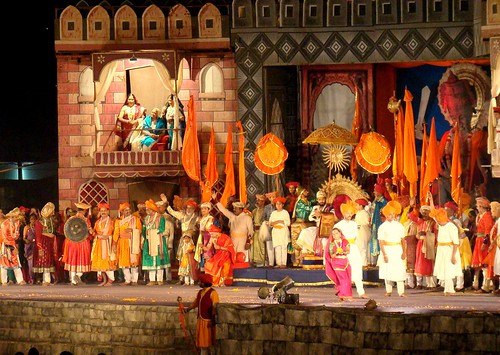
Asia's greatest MEGAPLAY

Picture: Courtsey FlickrToday we watched Asia's greatest, world's second largest, megaplay - जाणता राजा.
It is based on the life of the greatest Hindu warrior, leader, statesman and icon Shivaji Maharaj.
"Jaanata Raja" is being performed in Nagpur from 18th to 28th December this year.
It has a cast of about 300 artists. Only the key roles are fixed and artists for other roles are chosen from the local talent pool. The show is full of colours and the acts with horses and elephants receive an obvious thunder of applause.
But the most happening event is the coronation of Shivaji Maharaj.
The presentation, the sound effects, the fireworks - the entire ambiance takes you three centuries back and you tell yourself that this is how the real rAjyAbhiSheka must have taken place - this is how the world must have looked when the first Hindu simhAsana came to existence after centuries of Islamic invasion.

The play - as the title goes - is more about Shivaji the ruler, than Shivaji the warrior. Hence there is more emphasis on events like -
  • a patil being punished for misbehaving with a widow
  • hundis full of jewels found while constructing a fort, being deposited to the treasury by the workers - and their refusal to take prizes for this act
  • Shivaji's letter to his officers on how an ideal administrator should behave with citizens
  • Shivaji punishing his own maternal uncle for corruption
  • Aurangzeb's speech before his courtsman why it is difficult to defeat Shivaji (because of his good administration and people's faith on him) ... etc
The well known battle-events of Pratapgadh (Afzalkhan defeated), Paawan Khind (Bajiprabhu Deshpande's martyrdom), Lal Killa (attack on Shaistekhan), Kondhana (Tanhaji's martyrdom) etc find relatively lesser share.

The day we went to watch the megaplay witnessed a turn-out of 19200 spectators. People from neighboring districts of Vidarbha and Madhya Pradesh had come to Nagpur to watch the show.
Many schools had organised free or discounted passes for their students.
One could find people who have watched the megaplay every time it visited Nagpur.
"Jaanata Raja" is more than a play for lakhs and lakhs of people here.


The megaplay is written by "Shivashahir" Babasaheb Purandare, who is a phenomenon in himself. If there is a single man who deserves the credit for taking Shivaji to every home in Maharashtra, it's him. He has been doing this one job tirelessly throughout his life (of 86 years now). That's what is called one man - one life - one mission.
Incidently yesterday (Dec 24) was his 86th birth annivarsary.
राजमान्य राजश्री शिवशाहिर श्रीयुत बळवंत मोरेश्वर तथा बाबासाहेब पुरंदरे यांना मानाचा मुजरा ...


Could the timing be more apt for recollecting the life and times of Shivaji Maharaj ?
The nation is yet to emerge from the shadows of nov-26 terror attacks..
If Shivaji cannot inspire us at such a moment, then who can ?

Note: The picture in this post is taken from "Flickr" (http://farm3.static.flickr.com/2240/2219271152_3cc6265b7d.jpg?v=0)

Tuesday, December 9, 2008

Gita Jayanti

मार्गशीर्ष शुद्ध एकादशी (mArgaSIrSha Suddha ekAdaSI) was the day on which Lord Krishna told the bhagavad-gItA to Arjuna on the battlefields of Kurukshetra. The day is celebrated as गीता जयंती (gItA-jayantI) all over the world.
This year it falls on Dec-9.
I have been fortunate enough to have heard/read a little bit about gItA in last few years.
A good orator with some depth of understanding in gItA can possibly go on unfolding the beauty of this devine song for hours together, but some one of my stature should only quote some of the observations etc made by them.

1.
gItA holds the entire dharma (not to be confused with religion).
Its first sholka starts with ध dha:
धर्मक्षेत्रे कुरुक्षेत्रे समवेता युयुत्सवः । (1.1)

And the last one ends with म ma:
यत्र योगेश्वरः कृष्णो यत्र पर्थो धनुर्धरः ।
तत्र श्रीर्विजयो भूतिर्ध्रुवा नीतिर्मतिर्मम ॥ (18.78)

2.
It is a relatively very small text (only 700 shlokas-18 chapters), but has attracted many philosophers for many a thousand years, who keep on interpreting the text as it suits themselves - right from Adi Shankara to Mahatma Gandhi and beyond. Lokamanya Tilak interpreted it as the karmayoga, Gandhiji as the anAsakti-yoga. But the gItA herself is both and beyond the both.

3.
Today's engineers and enterprenuers are looking for the seeds of management in it.
While in Bengaluru, my friend's roommate was asking about it - she was told that gItA can teach her management. When I was asked, I said that I see the best way to manage your activities being told in a single shloka :
यत्करोषि यदश्नासि यज्जुहोसि ददासि यत् ।
यत्तपस्यसि कौन्तेय तत्कुरुष्व मदर्पणम् ॥ (9.27)
Meaning - Whatever you do, whatever you eat, whatever you offer, and whatever austerities you perform - do that, O Son of Kunti, as offerings to me !

What better motivation for doing each of your tasks in the best possible manner, than that of offering it to the Almighty ?

4.
Is gItA the best book on psychology/psychotherapy ?
Of course yes.
These two shlokas summarize the very chain of how one loses his/her own mental health:
ध्यायतो विषयान्पुंसः सङ्गस्तेषूपजायते ।
सन्ङ्गात्संजायते काम: कामात्क्रोधोऽभिजायते ॥
क्रोधाद्भवति संमोह: संमोहात्स्मृतिविभ्रम: ।
स्मृतिभ्रंशाद्बुद्धिनाशो बुद्धिनाशात्प्रणश्यति ॥ 2.62-63
Meaning - While concentrating on the objects of the senses, a person develops attachment for them, and from such attachment desire develops, and from that (due to non-fulfilment) anger arises. From anger arises complete delusion, and from that, bewilderement of memory. When memory is bewildered, intelligence is lost. And losing intelligence, one perishes.

5.
And psychotherapy?
Again, yes.
gItA starts with Arjuna in a state of a shock - limbs quivering and mouth drying up. (सीदन्ति मम गात्राणि मुखं च परिशुष्यति । - 1.28)
And ends with him stating that "I am now firm and free from doubt and am prepared to act according to Your instructions" (स्थितोऽस्मि गतसन्देह: करिष्ये वचनं तव ॥ - 18.73)

But this change is not easy to bring. At times Krishna shows him the carrot - you shall reach heaven if you die or else rule the earth if you win (हतो वा प्राप्स्यसि स्वर्गं जित्वा वा भोक्ष्यसे महीम् । - 2.37). And at other times the stick - by showing the Vishwaroopa, looking at which Arjuna says he is disturbed with fear (भयेन च प्रव्यथितं मनो मे । - 11.45)
At times Krishna discusses the eternity of the AtmA to dissuade Arjuna from the concept of killing and sin of killing (नैनं छिन्दन्ति शस्त्राणि नैनं दहति पावकः - 2.23).
At other times he simply tells him as a friend to 'be a man and fight' (क्लैब्यं मा स्म गमः - 2.3)

Most interesting is his reaction after Arjuna is convinced and is ready for the war.
After telling entire gItA, Krishna says - deliberate on this fully, and then do what you wish to do (विमृश्यैतदशेषेण यथेच्छसि तथा कुरु ॥ - 18.63)
Is this not the best way of motivating someone ?
Instead of simply ordering him to do what he should, Krishna increased Arjuna's level of understanding, removed any doubts he had, and then asked him to behave according to his conscience.

...
Thus, gItA is like the holy river of Ganga. How much of its water one carries back home depends on the capacity of the container s/he carries ...